

Antioxidant Considerations for CoQ10 Forms
CoQ10 is present in the body in two forms: ubiquinone and ubiquinol. These forms differ in their role within redox activity, antioxidant function, conversion requirements, and relative bioavailability. From a formulation perspective, those distinctions can influence ingredient selection, product positioning, and performance considerations across health categories.
The CoQ10 Redox Cycle
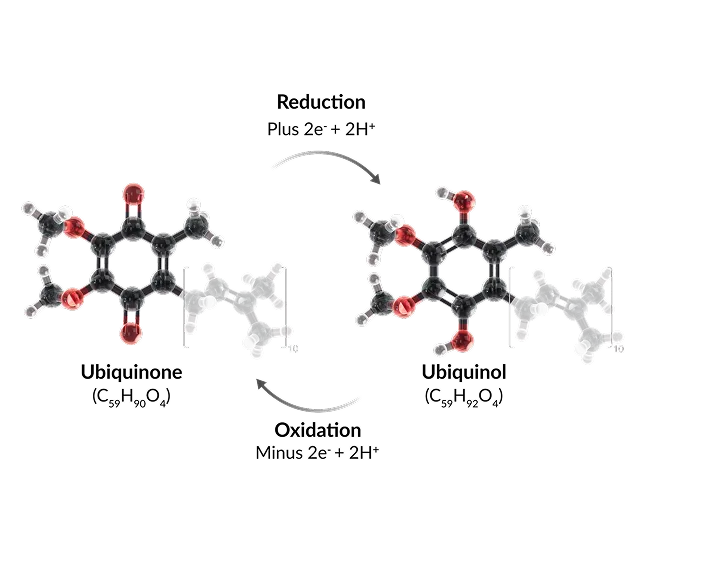
Ubiquinone and ubiquinol are part of the same CoQ10 redox system. Ubiquinone is the oxidized form of CoQ10, while ubiquinol is the reduced antioxidant form. Through normal cellular processes, the body converts these forms back and forth as CoQ10 accepts and donates electrons.
This redox cycling helps explain CoQ10’s biological relevance. Within the mitochondrial electron transport chain, ubiquinone accepts electrons and is reduced to ubiquinol. Ubiquinol can then donate electrons and return to ubiquinone, supporting electron transport and cellular energy production as part of normal mitochondrial activity.
CoQ10 Redox Cycle
Functional Differences Between Ubiquinol and Ubiquinone
The following table summarizes how ubiquinone and ubiquinol function within the body’s CoQ10 redox cycle, antioxidant systems, and circulating CoQ10 pool.1-8
CoQ10 Function
Ubiquinone
Ubiquinol
CoQ10 Form
Oxidized form of CoQ10
Reduced form of CoQ10
Role in Redox Cycling
Accepts electrons and is reduced to ubiquinol
Donates electrons and is oxidized back to ubiquinone
Role in the Electron Transport Chain (ETC)
Participates in electron transfer by accepting electrons from ETC complexes
Participates in electron transfer by donating electrons further along the ETC
Antioxidant Function
Must be reduced to ubiquinol before performing antioxidant activity
Performs antioxidant functions in its reduced state without first requiring conversion
Lipid-Phase Activity
Part of the CoQ10 redox system within lipid-rich mitochondrial membranes
Active within lipid environments, including cellular membranes, mitochondrial membranes, and lipoproteins
Circulating Form
Present in blood as part of total CoQ10
Predominant form of CoQ10 found in circulation
Conversion Consideration
Requires reduction to ubiquinol to perform antioxidant functions
Already in the reduced antioxidant form
CoQ10 Form
Ubiquinone: Oxidized form of CoQ10
Ubiquinol: Reduced form of CoQ10
Role in Redox Cycling
Ubiquinone: Accepts electrons and is reduced to ubiquinol
Ubiquinol: Donates electrons and is oxidized back to ubiquinone
Role in the Electron Transport Chain (ETC)
Ubiquinone: Participates in electron transfer by accepting electrons from ETC complexes
Ubiquinol: Participates in electron transfer by donating electrons further along the ETC
Antioxidant Function
Ubiquinone: Must be reduced to ubiquinol before performing antioxidant activity
Ubiquinol: Performs antioxidant functions in its reduced state without first requiring conversio
Lipid-Phase Activity
Ubiquinone: Part of the CoQ10 redox system within lipid-rich mitochondrial membranes
Ubiquinol: Active within lipid environments, including cellular membranes, mitochondrial membranes, and lipoproteins
Circulating Form
Ubiquinone: Present in blood as part of total CoQ10
Ubiquinol: Predominant form of CoQ10 found in circulation
Conversion Consideration
Ubiquinone: Requires reduction to ubiquinol to perform antioxidant functions
Ubiquinol: Already in the reduced antioxidant form
Ubiquinol’s Antioxidant Function
Ubiquinol has a distinct role as the reduced antioxidant form of CoQ10. As a lipid-soluble antioxidant, ubiquinol functions within lipid-rich environments, including mitochondrial membranes and lipoproteins. Lipid structures are naturally exposed to oxidative processes, making antioxidant activity relevant to ingredient selection and product positioning.
Ubiquinol helps neutralize free radicals and supports the body’s antioxidant defense system. After donating electrons, ubiquinol is oxidized back into ubiquinone, allowing the redox cycle to continue. For formulations positioned around cellular health, oxidative balance, or healthy aging, this antioxidant role is an important consideration.


Bioavailability and Conversion Requirements
A primary difference between ubiquinol and conventional CoQ10 supplements is conversion. Kaneka Ubiquinol® requires no conversion to be absorbed into the blood and to perform its antioxidant functions.7,8 Ubiquinone must be converted to ubiquinol in the body before it can act as an antioxidant in the reduced form.
For formulators, this distinction can influence ingredient strategy. Kaneka Ubiquinol® is more bioavailable than CoQ10. Kaneka Ubiquinol® is three times better absorbed than a conventional CoQ10 supplement.9,10 When compared with conventional CoQ10, the same amount of Kaneka Ubiquinol® leads to higher CoQ10 levels in the blood.11
Research demonstrates that 200 mg of Kaneka Ubiquinol® increases ubiquinol levels by approximately eight times compared to baseline in healthy adults when taken daily for at least 30 days.9
Delivery Formats and Absorption Considerations
Formulation strategy depends on the form of CoQ10 selected and how that ingredient is delivered. Format selection can influence how CoQ10 is incorporated into a finished product, how stability is managed, and how the product is presented to the consumer.
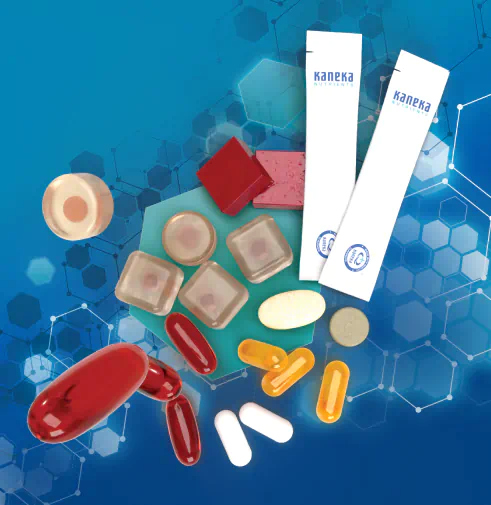
Kaneka Ubiquinol® is compatible with a range of delivery formats, supporting application across capsules, softgels, powders, stick packs, and other product concepts. This flexibility allows brands to align ingredient selection with format requirements, positioning strategy, category expectations, and commercial feasibility while maintaining attention to absorption and stability factors.

Ingredient Selection for CoQ10 Formulations
For R&D teams, formulators, product managers, and ingredient buyers, choosing a CoQ10 ingredient should account for mechanism, conversion requirements, bioavailability, antioxidant function, delivery format, and quality controls. These factors can shape both technical development and market positioning.
Kaneka Nutrients brings decades of CoQ10 expertise to ingredient development. Through controlled manufacturing, proprietary expertise, and integrated quality systems, Kaneka supports bioidentical, structurally consistent CoQ10 ingredients developed with formulation performance, quality, and consistency in mind. For premium supplement brands, this level of control helps support ingredient integrity, quality, purity, and compliance-conscious product development.
Partner With Us for Premium CoQ10 Ingredients
Selecting the appropriate form of CoQ10 requires evaluating mechanism, antioxidant function, conversion, and bioavailability in the context of the finished product. Kaneka’s team can help formulators make informed ingredient selections aligned with product strategy and development goals.
Get the Kaneka Nutrients
Advantage
With a reputation for setting the industry gold standard, Kaneka Nutrients is your trusted supplier of the premium nutritional ingredients you need to offer customers the high-quality products they are seeking.
We’re here to help
Frequently Asked Questions
Ubiquinol and ubiquinone are two forms of CoQ10 that cycle between reduced and oxidized states as part of normal cellular processes. Ubiquinone is the oxidized form, while ubiquinol is the reduced antioxidant form.
The selected form can influence absorption, conversion requirements, antioxidant function, and how the ingredient is positioned within a finished product.
- Ernster L, Forsmark-Andrée P. Ubiquinol: an endogenous antioxidant in aerobic organisms. Clin Investig. 1993;71(8 Suppl):S60-5.
- Bentinger M, Brismar K, Dallner G. The antioxidant role of coenzyme Q. Mitochondrion. 2007;7(Suppl):S41-50.
- Becker WM, Deamer DW. Energy from chemical bonds: the aerobic mode. In: The World of the Cell. 2nd ed. Benjamin/Cummings; 1991:275-313.
- Frei B, Kim MC, Ames BN. Ubiquinol-10 is an effective lipid-soluble antioxidant at physiological concentrations. Proc Natl Acad Sci U S A. 1990;87(12):4879-83.
- Yamashita S, Yamamoto Y. Simultaneous detection of ubiquinol and ubiquinone in human plasma as a marker of oxidative stress. Anal Biochem. 1997;250(1):66-73.
- Tang PH, Miles MV, DeGrauw A, Hershey A, Pesce A. HPLC analysis of reduced and oxidized coenzyme Q(10) in human plasma. Clin Chem. 2001;47(2):256-65.
- Sabbatinelli J, Orlando P, Galeazzi R, et al. Ubiquinol ameliorates endothelial dysfunction in subjects with mild-to-moderate dyslipidemia: a randomized clinical trial. Nutrients. 2020;12(4):1098.
- Kubo H, Yamamoto Y, Fujisawa A. Orally ingested ubiquinol-10 or ubiquinone-10 reaches the intestinal tract and is absorbed by the small intestine of mice mostly in its original form. J Clin Biochem Nutr. 2023;72(2):101-6.
- Hosoe K, Kitano M, Kishida H, Kubo H, Fujii K, Kitahara M. Study on safety and bioavailability of ubiquinol (Kaneka QH) after single and 4-week multiple oral administration to healthy volunteers. Regul Toxicol Pharmacol. 2007;47(1):19-28.
- Ikematsu H, Nakamura K, Harashima S, Fujii K, Fukutomi N. Safety assessment of coenzyme Q10 (Kaneka Q10) in healthy subjects: a double-blind, randomized, placebo-controlled trial. Regul Toxicol Pharmacol. 2006;44(3):212-18.
- Langsjoen PH, Langsjoen AM. Comparison study of plasma coenzyme Q10 levels in healthy subjects supplemented with ubiquinol versus ubiquinone. Clin Pharmacol Drug Dev. 2014;3(1):13-7.
These statements have not been evaluated by the Food and Drug Administration.
This product is not intended to diagnose, treat, cure, or prevent any disease.
These statements have not been evaluated by the Food and Drug Administration. This product is not intended to diagnose, treat, cure, or prevent any disease.
All scientific illustrations are the property of Kaneka Nutrients and may not be reproduced without permission.